The question most travellers ask first is also the hardest to answer with a single number: what does a Kenya safari cost? A week that takes in a Rift Valley park and the Masai Mara can be a camping trip at around USD 1,400 to 2,400 per person, a comfortable mid-range journey at USD 2,000 to 4,500, or a luxury fly-in safari that starts around USD 5,000 and climbs quickly. The gap is real, but it is not mysterious. Park fees, camp standard, season and whether you drive or fly explain most of it.
This breakdown looks at a typical safari that starts in Nairobi and visits parks such as Amboseli, Lake Nakuru or Naivasha, and the Mara, because that is the trip most first-time visitors book. The figures are typical ranges for 2026, not a fixed price list. Official park fees change, luxury camps publish seasonal rates, and a private vehicle for two people costs more per person than the same vehicle for four.
What You Are Actually Paying For
A safari quote is a bundle. If you only compare the headline number, you can miss the items that make two trips look similar on paper and feel very different on the ground.
Daily entry fees, especially in the Masai Mara, can be a large share of a mid-range week, and they rise in the high season.
This is where budget camping, comfortable lodges and luxury tents diverge most clearly, including meals and location.
A private 4×4 with a driver-guide is the core of the trip. Internal flights are optional, but they change both cost and pace.
Typical Price Bands for a Seven-Day Safari
The ranges below assume two people sharing a room and a private or small-group vehicle, with park fees and safari meals included, and without international flights. They line up with the kind of week described in our seven-day Kenya safari itinerary.
| Style | Typical cost per person, 7 days | What it usually means |
|---|---|---|
| Budget camping or basic tents | USD 1,400 to 2,400 | Simple camps, often shared or small-group vehicles, essential facilities |
| Comfort mid-range | USD 2,000 to 4,500 | Tented camps or lodges with private bathrooms, reliable vehicles, good guiding |
| Upper mid-range | USD 4,500 to 6,500 | Stronger locations, better camp atmosphere, more space in the vehicle |
| Luxury | USD 6,500 to 12,000+ | High-end lodges or conservancy camps, often with flights and a higher staff-to-guest ratio |
A couple travelling alone in a private vehicle sits at the higher end of each band. A family of four sharing one Land Cruiser brings the per-person cost down, because the car, guide and some vehicle fees are split. Solo travellers should expect a supplement unless they join a small shared departure. A two-week trip, such as our 14-day Kenya safari itinerary, does not simply double a seven-day price, but it does add more park-fee days, more nights and often a flight to the coast.
The Costs That Sit Inside the Quote
Park, reserve and conservancy fees
Kenya’s fees are set by more than one authority. Most national parks are managed by the Kenya Wildlife Service. The Masai Mara National Reserve is managed by Narok County, and the Mara Triangle has its own administration. Private conservancies charge their own fees, often bundled into the camp rate. That patchwork is why two honest quotes can differ, and why a “cheap” Mara safari in August can still look expensive: non-resident adult entry to the reserve has in recent seasons been around USD 100 per day from January to June and around USD 200 per day from July to December. Confirm the current tariff when you book, because local authorities do adjust rates.
Other popular parks, including Amboseli, Lake Nakuru, Nairobi National Park and the Tsavo parks, typically charge a lower daily fee than the Mara in high season, often in a band around USD 80 to 90 for a non-resident adult, subject to official change. Tickets may be valid for a limited window, and a late morning exit can trigger another day. Vehicle fees are usually separate. Your operator should list every fee that is included. If a quote sits far below the ranges above, ask which parks, which nights and which fees are actually in it.
The vehicle and guide
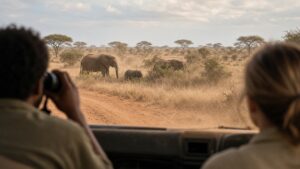
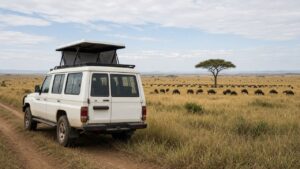
A well-maintained 4×4 with a roof hatch and a knowledgeable driver-guide is worth more than a slightly nicer room. On a private safari the vehicle is yours for the day, which means you can stay with a sighting or return to camp when you want. Shared group departures cost less and run on a fixed timetable. Fuel, park vehicle fees and the guide’s time are built into most inclusive quotes. They are not a reason to tip less later, but they are a reason to be wary of a price that seems to omit the car altogether. A 4×4 rental only makes sense if you know the self-drive rules; many visitors are better with a private driver.
Camps and meals
Accommodation is the other large variable. A simple campsite dinner and a canvas tent are a very different night from a luxury conservancy camp. Mid-range tented camps are the usual sweet spot: proper beds, good food, a shower, and a location close enough to the gates that you are not driving for hours before the first game drive. Full board is standard on safari. Drinks, laundry and premium wines are not always included, even in expensive camps.
- The Maasai Mara and Nakuru Wildlife tour is a clear mid-length benchmark.
- The Ultimate Kenya National Parks tour is the fuller, park-heavy version.
- For a safari-and-beach finish, see the Bush to Beach Coast Escape.
Extras People Forget to Budget
- International flights into Nairobi or Mombasa
- The Kenya eTA, typically USD 30 for a standard single-entry application
- Tips are not required or expected. Drivers set their own fair prices, but they appreciate a tip, so it is always a nice gesture.
- A Masai Mara balloon flight, often USD 450 to 650 per person
- Internal flights, often USD 150 to 350 per sector
- Drinks, laundry, spa treatments and souvenirs
- Travel insurance that covers safari activities and medical evacuation
Balloon flights and domestic flights are the upgrades that change a mid-range total most quickly. They are worth it when they save a long road day or give you a dawn over the plains, but they should be optional lines in the quote, not surprises on the last invoice. Our Masai Mara balloon safari guide explains what the morning includes. For entry paperwork, see Kenya visa and eTA.
Season Makes a Real Difference
July to October is the most expensive period in the Mara, because demand and reserve fees are both higher. January and February are also popular and can be priced firmly. April and May, and parts of November, often bring lower lodge rates and fewer visitors, at the cost of more rain and the chance that a camp is closed for a few weeks. A mid-range week in low season can land at the bottom of the band above; the same lodges in August can sit at the top, even before the higher Mara fee.
Use our best time to visit Kenya guide to match month and budget, and do not assume a “low season bargain” if your dates still fall inside the July–December Mara fee period.
How to Read a Quote
A useful quote names the nights, the parks, the type of vehicle, whether game drives are private, and which fees, meals and transfers are included. It should also say what is excluded. Be cautious if the only number you receive is a single headline with no day-by-day outline. Ask about park-fee increases, child rates, single-room supplements and the cutoff for the last morning in the Mara, because a late exit can add another fee day.
Existing KenyaAssist blog posts sometimes quote specific excursion prices in US dollars, and some older pages leave prices out of the running text altogether. In this guide, and in the newer planning posts, selling prices are given as USD ranges. Local-currency costs you meet on the road, such as a market purchase or a small tip paid in shillings, are separate from the safari quote.
Ways to Keep the Cost Sensible
Travel with two or four people in one vehicle rather than as a solo guest. Choose mid-range camps just outside a busy gate if the location still allows an early start. Drive the shorter transfers and fly only the long ones. Visit the Mara in June or November instead of August if a river crossing is not your only goal. And resist the urge to add a sixth park to a seven-day trip; extra miles rarely feel like better value than one more night in the right place.
Frequently Asked Questions
How much does a 7-day Kenya safari cost?
Many mid-range private trips fall around USD 2,000 to 4,500 per person sharing, excluding international flights. Budget camping can be lower, and luxury fly-in trips are often much higher.
Are park fees included in safari prices?
They should be, on a complete quote, but always check. The Masai Mara fee in particular can change the total between low and high season.
Is Kenya cheaper than Tanzania?
It depends on the parks and the season. A week in the Mara and Amboseli can be comparable to a northern Tanzania circuit, but the fee structures differ. See our Kenya or Tanzania safari comparison.
Does a balloon safari cost extra?
Usually yes. Treat it as an optional extra at around USD 450 to 650 per person, and confirm the current rate when you book.
What should I tip on safari in Kenya?
Practices vary by camp, but many guests budget a combined USD 10 to 25 per guest per day for the driver-guide and camp team, adjusted for the style of trip. When in doubt, ask your operator for their current guideline.
Can I reduce the cost by self-driving?
Sometimes, in parks where self-drive is allowed, but you still pay park fees, fuel, a suitable 4×4 and your own logistics. Read our Kenya self-drive safari guide before choosing that route.
Get Your Free Custom Kenya Safari Quote Today!
Tell us your dates, group size and style of camp, and we will send a clear breakdown with park fees and transfers included.
Browse Multi-Day Tours Explore Short Excursions